
Swagbucks Play Games + Surveys
ProdegeLifestyle
4.149.67K Reviews
- Version
- 5.56.1
- Installs
- 10.00M
- Age Rating
- Teen
Screenshots
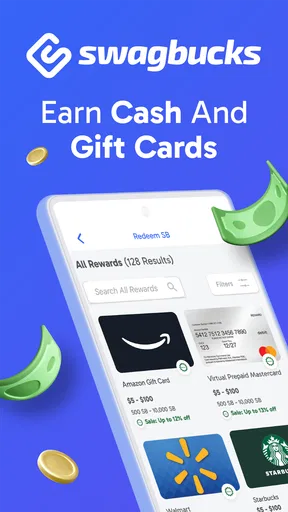
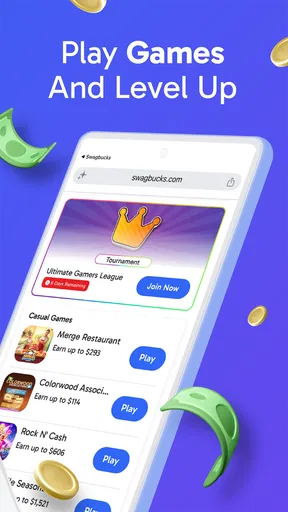
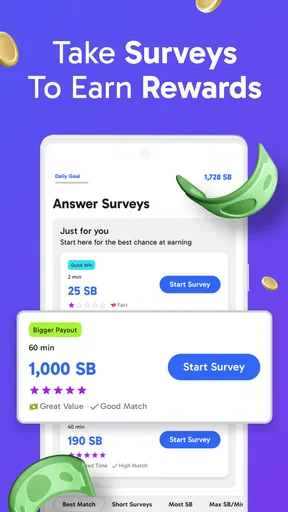
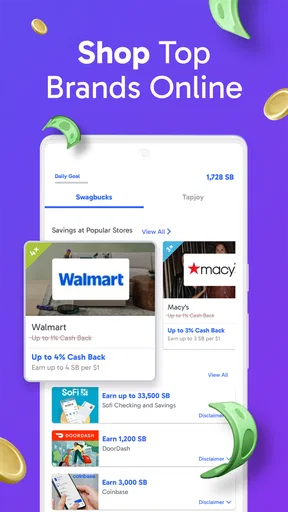
Our Review of Swagbucks Play Games + Surveys
 Analysis by Appyee
I approached Swagbucks Play Games + Surveys as a small rewards tool rather than a shortcut to easy money, and that distinction shaped my experience. The app, developed by Prodege, combines mobile games, surveys, and opinion-sharing tasks in one Lifestyle app. It is free to install, aimed at a Teen audience, and works on devices running Android 8.0 or later.
My first impression was that its appeal comes from variety. When one activity feels repetitive or is not available, I can move to another instead of being locked into a single earning method. That flexibility makes it more practical than a survey-only app, although it does not remove the usual trade-off: rewards require time, attention, and patience.
How the current Swagbucks experience feels
The app’s central idea is straightforward. I browse available tasks, choose something that fits my spare time, complete the required activity, and build up rewards. Games suit moments when I want something more interactive, while surveys are better when I have a few quiet minutes and can answer questions carefully.
That sounds simple, but the quality of the experience depends heavily on matching the task to the moment. I would not open it expecting a guaranteed stream of worthwhile offers. Instead, I treat it like a rotating noticeboard: some opportunities are useful, some are too time-consuming, and some are simply not a good match for me.
The app has a 4.2 average from around 450 thousand ratings, with more than 10 million installs. Those figures suggest that Swagbucks has reached a broad audience, but they should not be read as a promise that every user will have the same selection of tasks or the same results. Reward apps are particularly sensitive to location, profile, device, and changing offer availability.
I also found that the best way to use it is with a clear time limit. If I start a game or survey without deciding how long I am willing to spend, it is easy to continue simply because I have already invested effort. A short session keeps the app recreational instead of turning it into an obligation.
Games and surveys serve different purposes
The game section is the more appealing option when I want to make idle time feel slightly more productive. It can be a reasonable companion during a commute, a waiting room, or a quiet evening. However, I would not choose a game solely because a reward is displayed beside it. The real question is whether I would enjoy playing it even if progress were slower than expected.
Surveys are more direct, but they demand concentration. I have to read questions closely, keep my answers consistent, and accept that some questionnaires may not suit my profile. Rushing through them is a poor strategy because careless responses make the process frustrating and can waste more time than they save.
The useful balance is to use games for relaxed, open-ended sessions and surveys for focused windows of time. That division is one of the app’s practical strengths, because it lets me choose an activity based on my energy rather than forcing every visit into the same routine.
What has changed for the current version
The current version is 5.54, and the app has been available since October 9, 2013. That long presence matters because Swagbucks is not a brand-new experiment trying to prove that the rewards-app model can work. It is an established product that has had time to refine its general approach around tasks, games, and opinions.
At the same time, I would be careful about interpreting a version number as evidence of a particular feature or redesign. A version label alone does not tell me that every part of the app has changed recently, and I would not expect it to guarantee that an offer interface or task list will remain identical over time. The important current fact is that the app continues to present multiple ways to participate rather than focusing on only one category.
For an existing user, that continuity is reassuring. Someone who already understands the basic rewards model does not need to learn an entirely different type of product. A new user, however, should still expect a little trial and error before discovering which activities are genuinely worthwhile for their own routine.
I see the evolution of the app less as a dramatic transformation and more as the maturing of a familiar concept. Its value comes from keeping several small activities together. That is convenient, but it also means the app’s usefulness can rise or fall with the quality and availability of individual offers.
How I would use it in an ordinary day
Imagine that I have fifteen minutes before leaving for an appointment. I would open the app and first scan for a survey that appears short enough to finish without rushing. If the available options look unsuitable, I would avoid starting one merely because it is visible. A partially completed task is not automatically a good use of time.
Later, if I have a longer break, I might look at the game offers. Here I would pay attention to the commitment involved before beginning. A game that asks for steady progress over several sessions should be treated differently from one that fits a brief visit. The non-obvious advantage is that I can use the app as a time-management choice: surveys for focused gaps, games for relaxed downtime.
I would also keep a simple personal note about which activities felt worthwhile. This is not a feature I am claiming the app provides; it is a habit that makes the experience more honest. After a few sessions, I can recognize whether I am enjoying the activity or merely chasing a displayed reward. That distinction helps prevent the app from taking more attention than it deserves.
Another useful habit is to read the task instructions before committing. With reward-based games, the attractive part is often the idea of playing, but the practical value depends on what progress is expected. If the required effort does not fit my schedule, I skip it. This is one of the clearest ways to reduce frustration.
Where it compares well with ordinary alternatives
Compared with a standard survey app, Swagbucks feels less narrow because I can switch to games when answering questions becomes tiring. That variety is the main reason I would recommend it over a survey-only option to someone who dislikes repetitive forms.
Compared with a regular mobile game, the rewards angle gives my play sessions an additional purpose. Still, a conventional game may be better for someone who wants deeper gameplay, a carefully balanced progression system, or entertainment without thinking about task requirements. Swagbucks is not a replacement for a dedicated gaming experience.
Compared with cashback or shopping-focused rewards services, this app is more suitable for people who want activities they can complete without making a purchase. That does not make it universally better. Someone who already shops online frequently may prefer a service centered on purchases, while someone with spare time but little shopping activity may find Swagbucks more relevant.
The key comparison is therefore not “which app pays the most?” That question is difficult to answer consistently because task availability changes. The better question is whether this combination of games and surveys fits the way I already spend spare time. For me, the variety is more valuable than any single task.
What existing users may notice over time
Regular users will probably benefit most from learning their own patterns. Some days may offer appealing surveys; other days may be better suited to games. I would avoid judging the whole app from one disappointing session, but I would also avoid assuming that persistence alone makes every task worthwhile.
The app works best when I stay selective. I do not need to open every offer, and I do not need to finish an activity simply because I started it. That sounds obvious, yet it is an important trade-off in rewards apps: the displayed opportunity can create pressure to continue, even when the time cost no longer feels reasonable.
I would also expect the experience to feel different on an older device than on a newer one, even though the minimum operating-system requirement is Android 8.0. Compatibility means the app can run on supported software; it does not promise that every device will feel equally quick or comfortable. For users with limited storage or an older phone, that practical consideration matters before making the app part of a daily routine.
Privacy and attention are other personal considerations. Surveys involve sharing opinions, and games can encourage longer sessions. I recommend deciding in advance what information I am comfortable providing and how much time I am willing to give. The free price removes a financial barrier, but my time and attention are still resources.
Remaining gaps and genuine frustrations
The biggest limitation is unpredictability. I cannot assume that a particular type of survey or game will always be available when I want it. This makes the app less suitable for anyone looking for a fixed, dependable schedule or a clearly predictable return from every session.
Screening can also be frustrating. A survey may look promising and then turn out not to fit my profile. Even when that is a normal part of market research, it can make the process feel less efficient. I would not recommend the app to someone who becomes annoyed by answering preliminary questions without always reaching a full questionnaire.
Games bring a different weakness: the reward objective can compete with the fun. If I choose a title only for the reward, the required progression may feel like work. A dedicated game is usually the better choice when entertainment is the priority.
There is also a mental accounting problem. Small rewards can feel satisfying individually, but the total value should be judged against the time spent. I would never describe this as a substitute for employment or a reliable income source. It is better understood as an optional way to make selected spare moments more engaging.
Finally, the app may not suit people who want a completely passive experience. Although the basic concept is accessible, I still need to choose tasks, read requirements, answer honestly, and decide when to stop. Users who prefer automatic savings or purchase-based rewards may find a different category more convenient.
Who should try it and who should skip it
I think it is a good fit for adults and older teens who enjoy trying different mobile activities, can tolerate changing availability, and are comfortable treating rewards as a small extra rather than a promise. It is especially useful for someone who wants one place to browse both surveys and games instead of installing separate apps for each purpose.
I would recommend it to a friend who already plays casual mobile games and wants to see whether that pastime can be connected to rewards. I would also recommend it to someone who has occasional short breaks and prefers choosing from several task types rather than filling out surveys every time.
I would suggest skipping it if the main goal is predictable earnings, instant results, or uninterrupted gameplay. It is also a poor match for anyone unwilling to read conditions carefully or who feels compelled to complete every available offer. In those cases, a conventional game, a budgeting tool, or a shopping-rewards service may be a better use of time.
The Teen content rating is worth keeping in mind for households. Parents should still make their own decision about whether the combination of surveys, games, and reward-oriented activity is appropriate for a younger user. The rating does not replace personal supervision or a conversation about spending time online.
Practical habits that improve the experience
Set a session limit before opening a survey or game, then compare the experience with the time you actually spent.
Read the full task instructions before starting a game, especially when the objective appears to require repeated progress.
Keep answers consistent and thoughtful in surveys instead of rushing simply to finish.
Use the app selectively; skipping a poor-fit offer is often better than forcing yourself through it.
Judge the app over several different sessions rather than by one unusually good or disappointing day.
These habits do not change the available rewards, but they do change how much control I feel I have. The strongest users of this kind of app are not necessarily the people who spend the most time in it. They are the people who recognize when an activity fits their schedule and when it does not.
What I would watch going forward
For future use, I would pay attention to how clearly the app explains task expectations, how smoothly it handles switching between games and surveys, and whether the overall selection remains varied enough to justify keeping it installed. Those details matter more to me than a new visual style because they affect whether the app saves time or creates extra friction.
I would also watch how well the product serves existing users as it evolves. A mature rewards app needs to remain approachable for newcomers without making regular users feel that familiar workflows are constantly changing. The current version shows an ongoing product, but the real test is whether everyday use remains clear and worthwhile.
My final view is positive but measured. Swagbucks is best used as a flexible spare-time companion, not as a financial plan. I like being able to move between games and surveys, and the free entry makes experimenting easy. The trade-off is that availability, effort, and personal enjoyment can vary from one activity to the next.
If I were recommending it to a friend, I would say: try it with a timer, choose tasks carefully, and keep your expectations realistic. For someone who enjoys casual games and occasional surveys, it can add a little purpose to otherwise empty moments. For someone seeking guaranteed value from every minute, a more predictable alternative will probably feel better.
With its established history, current version 5.54, broad reach, and focus on several activity types, the app remains an interesting option in the Lifestyle category. I would keep it installed only if the available tasks continue to fit my routine. That is the honest measure of its success: not how exciting the promise sounds, but whether the experience earns a small place in my day.
Privacy and Permissions
See what permissions an app requests and how it handles your data.
- Location
- approximate location (network-based), precise location (GPS and network-based)
- Photos/Media/Files
- read the contents of your USB storage, modify or delete the contents of your USB storage
- Storage
- read the contents of your USB storage, modify or delete the contents of your USB storage
- Camera
- take pictures and videos
- Microphone
- record audio
- Wi-Fi connection information
- view Wi-Fi connections
- Other
- view network connections, pair with Bluetooth devices, access Bluetooth settings, connect and disconnect from Wi-Fi, control flashlight, full network access, change your audio settings, run at startup, control vibration, prevent device from sleeping, read Google service configuration
Verdict
Strengths of Swagbucks Play Games + Surveys
- Earn rewards from both mobile games and paid surveys.
- Offers gift cards and PayPal cash-out options.
- Easy to track points, offers, and redemption progress.
- Frequent bonus promotions can increase your earning potential.
- Available on both Android and iOS devices.
Limitations of Swagbucks Play Games + Surveys
- Some game offers require reaching demanding milestones.
- Survey availability varies by location and user profile.
- You may be screened out after answering several questions.
- Rewards can take time to process or arrive.
- Earning rates are usually modest for the time invested.
Other Releases by Prodege
View All
Swagbucks Trivia for Money
Trivia4.2
Similar Picks in This Category
View All
SmartThings
Samsung Electronics Co., Ltd.4.6

Google Home
Google LLC4.0

Pinterest4.2

Astrotalk - Talk to Astrologer
Astrology & Horoscope4.7

My Verizon
Verizon Consumer Group4.5

Samsung Wallet (Samsung Pay)
Samsung Electronics Co., Ltd.4.1
Frequently Asked Questions
What is Swagbucks Play Games + Surveys?
Swagbucks Play Games + Surveys is a rewards app that lets users earn points, commonly called SB, by completing activities such as answering surveys, playing selected mobile games, watching available content, shopping through tracked offers, and completing promotional tasks. After reaching the required redemption threshold, points can generally be exchanged for gift cards or other available rewards. The activities, offers, and earning rates may differ depending on your country and account.
Is Swagbucks Play Games + Surveys free to download and use?
The app is generally free to download, and you do not normally need to pay a subscription fee to create an account or access its standard earning activities. However, some game or shopping offers may involve optional purchases, subscriptions, or spending requirements, so it is important to read each offer’s conditions carefully. Never spend money solely to earn rewards unless the potential value and terms make sense for you.
How do users earn rewards in Swagbucks Play Games + Surveys?
Users can earn SB by completing eligible surveys, reaching milestones in supported games, trying partner services, shopping through qualifying links, and performing other tasks displayed in the app. Each activity has its own requirements, tracking rules, and deadline. Some rewards are credited quickly, while others may require verification or take several days. Carefully follow the instructions, especially when installing games or completing a specific level.
How can I redeem Swagbucks points, and how long does payment take?
Once you have accumulated enough SB, you can choose from the redemption options currently offered in your account, which may include digital gift cards, PayPal, or other rewards depending on your location. Minimum thresholds, availability, identity checks, and processing times can vary. Rewards are not always delivered instantly, so review the redemption information and ensure your account details are accurate before submitting a request.
Are Swagbucks surveys and game offers available to everyone?
No. Availability depends on factors such as your country, age eligibility, profile information, device, operating system, and current advertising campaigns. Surveys may screen you out when your answers do not match the requested audience, and game tracking can fail if installation or permission instructions are not followed. The app should be viewed as a way to earn occasional rewards rather than a guaranteed source of income.
